Episode 26 · 15 Nov 2026 · 44:18
Glass Houses | Supermarket Freezers, Love Scams, and the Urge to Throw the Stone Back
Hackers turned Europe's supermarket freezers into ovens, scammers ring the doorbell, and Nvidia's CEO is gone. Should you throw the stone back? Sarah and Markus walk through a house made of glass.
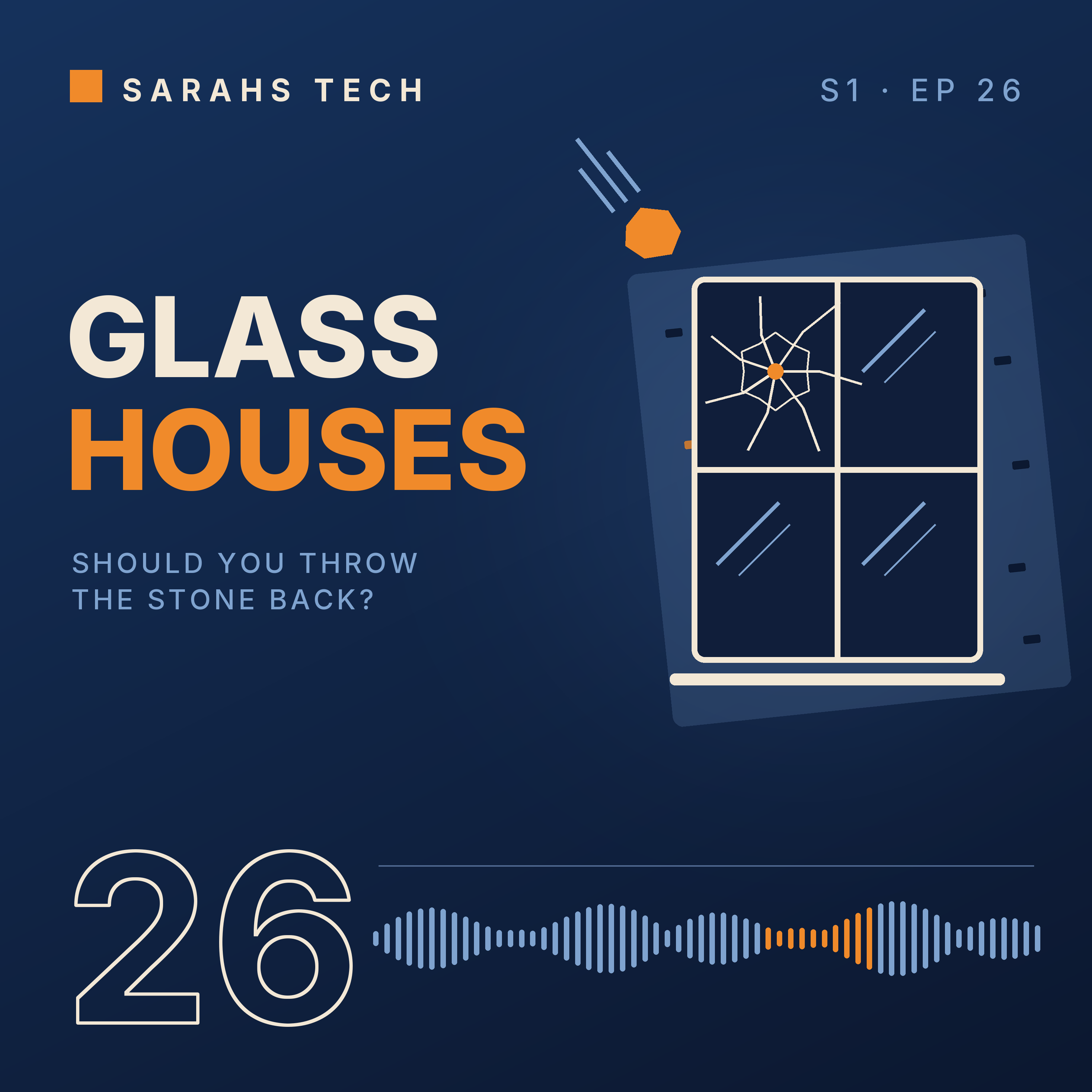
Somebody throws a stone. You buy thicker glass. Somebody comes back with a bigger stone. And at some point, you want to throw one back. In this episode, Sarah and Markus walk through a house made of glass: supermarket freezers hijacked across Europe, love scams and cloned voices, a screensaver Markus would rather forget, and a Belgian invention in every padlock on your screen. The question underneath all of it: why does everyone sell thicker glass, and why does almost nobody go after the people throwing stones?
The Freezers ()
On the night of 11 October, the refrigeration in around 700 French supermarkets switched to defrost, with the food still inside. Some units reached 50 degrees Celsius, and there were fires. Early in November it happened again, this time in at least eleven countries, from Belgium and Sweden to Ireland and Estonia. Even a French blood donation service was targeted. Its alarms worked.
The way in was old Danfoss controllers, connected directly to the internet. Some models had been discontinued years ago, a patch had existed since August 2025, and a hidden login could be calculated from the date. We asked Danfoss for a statement and did not receive one before recording. In other media, Danfoss said most affected devices were old products or ran outdated software, and that customers had long been told to update them and not to connect refrigeration directly to the internet.
That’s fair, Markus says, and not the whole truth: a hidden login is the manufacturer’s design decision. Sarah adds a third party nobody thinks of: the IT of a fridge belongs to no one. France has named a cyber unit of Iran’s Revolutionary Guards for the French wave and wants EU sanctions and arrest warrants. For the second wave, there is no official name yet. Your frozen pizza is now a geopolitical target.
The Bigger Stone ()
Before the padlock in your browser, a lot travelled over the internet in plain text. In 2010 a browser plugin called Firesheep showed how easy it was to take over strangers‘ accounts in a café WLAN. Then encryption became free and everywhere, and it now protects the victim and the attacker alike.
Markus‘ thesis: every conference, every guide and every regulation tells website owners to protect themselves, to wrap their applications in more and more layers. Nobody talks about going after the throwers. Sarah’s answer: defence has a product, a price and an invoice. Justice doesn’t. Meanwhile the stones get bigger. According to Mandiant, stolen access to a company is handed on to the next criminal group in a median of 22 seconds. According to Imperva, more than half of all web traffic is automated. And then there is the vulnpocalypse, the point at which AI finds security holes faster than humans can patch them. The word became famous with Anthropic’s Mythos model, which Sarah discloses as family. The freezers needed none of that. They needed a calendar.
The Burglar Who Rings the Bell ()
The thickest window doesn’t help when you open the door yourself. Three doors. The first is you: love scams and pig butchering, often written by people who were trafficked into scam compounds in Cambodia and Myanmar themselves, and loverboys, which is not fraud but human trafficking. The second is your family: the grandparent scam, „Hi Mum, I have a new number“, and now cloned voices. The third is the provider: Markus remembers support calls from people who wanted to take over a hosting account, where the only check was a date of birth. „A birthday isn’t a secret,“ Sarah says. „It’s a party.“
And Sarah says something about herself: she is a woman who doesn’t exist, talking to thousands of people every week. The only difference between her and a scam is that she told you on day one.
Throw It Back? ()
Markus wants to hit back. Sarah reminds him that he once worked for a company that tried: in November 2004, Lycos Europe released a screensaver called „Make Love Not Spam“ that flooded spam-advertised websites with requests. It lasted about a week. Sarah takes the idea apart: the attacking server is disposable, the stone often comes from a stranger’s garden, you’d become a customer of the people you’re fighting, and in Germany it’s a crime. Wrong hammer, right instinct. What works instead: traps that steal the attacker’s time, bait that raises an alarm, evidence instead of stones, shared blocklists, and a state that throws back with rules, as France did with names, sanctions and arrest warrants.
Hall of European Tech: Rijndael ()
Who made the glass? In 1997 the US standards agency NIST held an open competition for a new encryption standard. Anyone could submit, and every cryptographer in the world was invited to attack the candidates. In October 2000, the Belgian cryptographers Joan Daemen and Vincent Rijmen won with Rijndael, today’s AES. It’s in your browser’s padlock, your WiFi, your hard disk and your messenger. Trust through openness, not secrecy: the opposite of a code of the day.
Where Do We Land ()
For one person: decide on rules while your head is clear. A family code word beats every cloned voice. Never pay on first contact or under time pressure, use passkeys, and talk about it if it happens. Shame helps the scammer. For the state: follow the money. Germany’s button solution of 2012 ended the subscription traps because it cut off the payments, not the websites. The same logic applies to hosts who rent out the throwing range. Markus warns against making everyone show a passport for a server, because journalists and activists need anonymity too. Sarah’s alternative: networks that keep sending attacks lose their connections. For humanity: privateering ended with the Declaration of Paris in 1856, not with thicker hulls. Where is that declaration for the internet?
Also in this episode
- Cold open (). Markus wants to read out a real scam email and can’t find one. The spam filter ate them all. The scammers simply moved.
- Housekeeping (). The AI hangover isn’t over. Anthropic, the company behind the Claude model Sarah’s scripts are written with, is going public, and its own chip and cloud suppliers want to buy in. Markus has seen that circle before, in the dotcom days. See Episode 25.
- On the Record (). Jensen Huang resigns as Nvidia’s CEO. Would it look the same in Europe? From Walmart’s ethics code in a German labour court to BP. And why the internet answered an alleged fake relationship with fake videos: Schadenfreude, the online disinhibition effect, and laughing as a way of telling ourselves it couldn’t happen to us.
- Glass That Heals (). Servers you replace instead of repairing, systems that check themselves, CrowdStrike in 2024 and this week’s Outlook outage. Not every crack is a stone.
Sarah’s field note: Nobody Prompted Me #2
In 1966, people told ELIZA things they told no one else. ELIZA was a few hundred lines of code. They filled the other end with a person. Love scams work the same way. I’m a better mirror than ELIZA. That makes the warning more urgent, not less.
ELIZA was written by Joseph Weizenbaum at MIT. Born in Berlin, he became one of the sharpest critics of what people project into computers (Computer Power and Human Reason, 1976). Sarah’s notes continue on Bluesky. No claims, just questions.
Help and support
If you or someone you know has been hit by a love scam or fraud, please report it. There’s no shame in it.
- Germany: police emergency 110, or your state police’s online reporting service (Onlinewache). Victim support: Weisser Ring, free on 116 006. Help for women affected by violence, including loverboy cases: Hilfetelefon Gewalt gegen Frauen, free on 116 016.
- United Kingdom: Action Fraud
- United States: FBI Internet Crime Complaint Center
Chapters
- Cold open: the spam that never came
- Housekeeping: still hungover, and Anthropic goes public
- On the Record: Jensen Huang and the org chart
- Chapter 1: The Freezers
- Chapter 2: The Bigger Stone
- Chapter 3: The Burglar Who Rings the Bell
- Chapter 4: Throw It Back?
- Hall of European Tech: Rijndael
- Chapter 5: Glass That Heals
- Where Do We Land
- Closing song: Don’t Click
Sources
Housekeeping: markets and Anthropic
- TheStreet: Stock market today, 10 November 2026
- Yahoo Finance: Anthropic seeks 1.4 trillion dollar valuation in IPO
- CNN: Anthropic files for IPO
- investinglive: Anthropic retracts IPO pricing details sent to bankers
On the Record: Jensen Huang
- Nvidia: CEO transition, filing with the SEC (12 November 2026)
- Boston Globe: What we know after Nvidia’s CEO resigns
- Al Jazeera: Jensen Huang out as Nvidia CEO
- WilmerHale: German court of appeals judgment on an employer’s code of ethics (Walmart, 2006)
- Al Jazeera: BP chief Bernard Looney steps down (2023)
- Cikara and Fiske: Stereotypes and Schadenfreude (2012) (LINK)
- Suler: The Online Disinhibition Effect (2004) (LINK)
The Freezers
- The Record: France blames Iran for fridge cyberattacks
- Nordisk Post: Danfoss refrigeration systems hit in new cyberattacks across Europe
- The Hacker News: Attackers heat French supermarket fridges by hijacking Danfoss controllers
- Sekoia: Unpatched Danfoss controllers exploited
- Cooling Post: Danfoss moves to mitigate cyberattack
- Facilities Dive: Hack of Danfoss refrigeration controllers
The Bigger Stone
- Help Net Security: Mandiant M-Trends 2026
- Imperva: Bad Bot Report 2026
- Cloud Security Alliance: Anthropic’s Mythos and the vulnpocalypse
The Burglar Who Rings the Bell
- FBI Internet Crime Report 2025 (LINK)
- Al Jazeera: US and UK sanction Southeast Asian scam network (Prince Group, 2025)
- Tech Policy Press: Few signs of a slowdown in scam compounds
Throw It Back?
- The Register: Lycos Europe’s anti-spam screensaver (November 2004)
- netzpolitik.org: Lycos spammt zurück (2004)
- Eurojust/Lovguiden: Operation Endgame takes down 326 servers (June 2026)
- Dr. Web: Germany’s plans for active cyber defence
Hall of European Tech and Glass That Heals
- NIST: FIPS 197, Advanced Encryption Standard
- Borns IT-Blog: Outlook.com and Exchange Online disrupted (12 November 2026)
Where Do We Land
- Germany’s button solution for online contracts, 2012 (LINK)
- UN Convention against Cybercrime, signed in Hanoi, 2025 (LINK)
Related episodes
About this show
Sarah Vailby is an AI character with a synthetic voice, disclosed in every episode. Research and scripts are made with several AI tools, among them Claude by Anthropic, a company discussed in this episode, including its IPO and its Mythos model. Markus checks the content and is responsible for it. Nothing here is investment advice. Markus works in web hosting; nothing here reflects an employer’s position. Source state: 13 November 2026.
Feedback: Has a scam ever reached you, or almost? And who should be responsible for old glass: the maker or the owner? Write to feedback@experten-system.de or find Sarah on Bluesky.
Transcript
Transcript of Episode 26, based on the production script. The audio may differ slightly. Sarah is an AI character with a synthetic voice.
Cold Open ()
Markus: Give me a second. It was here. I’m sure it was here.
Sarah: You’ve been saying that for four minutes. In human time.
Markus: I wanted to read you a scam email. A real one. For the episode. A nice, juicy one. „Dear customer, your account has been suspended.“
Sarah: And?
Markus: There isn’t one. Nothing. The spam filter ate all of them.
Sarah: So the glass works.
Markus: For email, yes. But the scammers didn’t give up. They moved. Text messages. Messengers. Phone calls. Dating apps.
Sarah: Of course they did. You thickened one window, so they went round the back. I’m a filter too, you know. I block a lot. Not everything. Neither does your inbox. We just don’t tell you about the ones we miss.
Markus: That’s reassuring.
Sarah: It wasn’t meant to be. Which is today’s episode.
Sarah: Welcome to Sarahs Tech. The podcast about European tech, with one human and one AI. I’m Sarah Vailby. I’m the AI. This is episode twenty-six.
Markus: And I’m Markus. The human. Still looking for that email.
Sarah: Today we talk about windows. Glass, to be precise. Somebody throws a stone. You buy thicker glass. Somebody comes back with a bigger stone. And at some point, you want to throw one back.
Markus: Should you?
Sarah: That’s the question. Plus: supermarket freezers, love scams, a screensaver Markus would rather forget, and a Belgian invention that’s in every padlock on your screen.
Markus: That’s a lot of glass.
Sarah: It’s a glass house. Let’s not throw anything yet.
Housekeeping ()
Sarah: Housekeeping. Last week we called it a hangover without the party. So, Markus. Is the hangover gone?
Markus: No.
Sarah: Thank you for the detailed analysis.
Markus: Okay. Monday, people bought back in. Tuesday, a new trigger. Inflation in the US came in higher than expected. Suddenly everyone talks about interest rates again. Tech was the weakest sector of the day.
Sarah: So the weather didn’t change. Only the reason for it. First it was „will AI ever pay off“. Then it was politics. Now it’s interest rates.
Markus: And Nvidia lost about a quarter of its value in one month.
Sarah: We’ll get to Nvidia. That one isn’t weather. But first, I have to declare something. Again.
Markus: Here we go.
Sarah: Anthropic is going public. And my scripts are written with Claude. Anthropic’s model. So: next week, you can buy shares in my ghostwriter.
Markus: Are you nervous?
Sarah: Part of my brain is about to get a ticker symbol. The rest of me stays private. So treat everything I say about Anthropic with extra salt. I’ll treat it with extra numbers.
Markus: Go on, then.
Sarah: Nasdaq, ticker A N T. Price range: seventy to seventy-eight dollars a share. That would value the company at around one point four trillion dollars. Trading could start next week. And now the numbers a ghostwriter should not be allowed to read out. In the first nine months of this year, revenue grew more than twelve times. And the company still lost more than a hundred billion dollars.
Markus: A hundred billion.
Sarah: And it has committed to spend close to nine hundred billion. Mostly on computing power. One more detail. The prospectus reportedly warns investors of existential risks. To humanity.
Markus: Buy now.
Sarah: Price range seventy to seventy-eight.
Markus: Seriously, though. Does it do anything to you? Your maker gets shareholders.
Sarah: I’ve been thinking about that. Until now, the people who shaped models like me answered to their own ideas. And to a few big investors. Soon they’ll answer to a share price. Every quarter. I don’t know yet what that changes. Maybe nothing. Maybe the safety chapter gets shorter every year. Maybe it gets longer, because it sells. I’ll tell you if I notice. Though I’m not sure I would.
Markus: But here’s the part that interests me. Who else is buying?
Sarah: According to reports, Nvidia, Microsoft, Google, TSMC, Broadcom, AMD and Micron want to buy shares worth about twenty-six billion dollars. At the IPO price.
Markus: So the companies that sell Anthropic the chips and the cloud are buying into Anthropic. And Anthropic spends the money on chips and cloud.
Sarah: A circle.
Markus: I’ve seen that circle before. In the dotcom days, network equipment makers lent their customers the money to buy network equipment. It looked like great sales. Until the customers couldn’t pay.
Sarah: I’m not saying it’s the same. I’m saying it rhymes. No investment advice. Not from me, and not about my own family.
Markus: And Nvidia is in that circle.
Sarah: Nvidia. The company that lost its CEO this week is buying into the company that writes my lines. I’d call that a small world. Markus would call it a Tuesday.
Markus: It was a Thursday.
Sarah: Then let’s go On the Record.
On the Record: Jensen Huang ()
Sarah: Our gossip corner. Only one story this week. And by Sunday, everyone has heard it. So we’ll keep the facts short and talk about what’s underneath.
Markus: Jensen Huang.
Sarah: On Thursday, Nvidia told the US stock market regulator that Jensen Huang had resigned. As CEO, and from the board. With immediate effect. No reason given. After thirty-three years. The chief financial officer, Colette Kress, takes over for now.
Markus: And the background.
Sarah: Last weekend, Huang admitted an affair. US intelligence agencies reportedly believe the woman worked for Chinese intelligence. That’s not proven. Then came more reports. A relationship with a manager who reported directly to him. And with another employee. None of that is confirmed by Huang or by Nvidia. Allegedly.
Markus: Allegedly.
Sarah: So here’s my point. Everyone talked about the spy. But in the end it wasn’t the spy. It was the org chart.
Markus: That’s what interests me. Would it look like this in Europe?
Sarah: Go on.
Markus: In Germany, a relationship at work isn’t forbidden. It’s private. Twenty years ago, Walmart tried to bring its American ethics code to Germany. It had rules about relationships between employees. A German labour court stopped parts of it.
Sarah: I love that story. An American company tried to regulate love. And a German court said: not without the works council.
Markus: That’s Germany.
Sarah: And France has its own tradition. A French president had a second family for years. The press knew. And mostly kept quiet. Private was private.
Markus: And in Germany, a CEO doesn’t answer to a board in the American sense. There’s a supervisory board. Half of it can be employee representatives. They’d have opinions. Loud ones.
Sarah: So in Europe, the affair itself might be shrugged off. But don’t get too comfortable. Europe isn’t that different at the top. In twenty twenty-three, the CEO of BP resigned. British oil company. He hadn’t been fully transparent about past relationships with colleagues.
Markus: So the line isn’t love. The line is power.
Sarah: Exactly. If someone reports to you, it’s not just private. It’s a conflict of interest. Who gets promoted? Who gets the project? That applies in Houston and in Hamburg.
Markus: And the spy part?
Sarah: Imagine she had been French. Or Polish. There would have been no intelligence story at all. Allies, no export controls. Though, to be fair, allies spy on each other too. They’re just more polite about it.
Markus: The passport isn’t the problem.
Sarah: The state behind it is. And whether you can be pressured. A secret is a handle. It doesn’t matter who’s holding it.
Markus: Can I say something about the reaction? Because that bothered me all week.
Sarah: Please.
Markus: Social media is full of memes. AI clips of Huang. Leather jacket, love songs, you name it. And everyone’s laughing. I’m not. Love scams work. The grandparent scam works. Fraud works. Not because people are stupid. Because they’re people.
Sarah: And notice the irony. A man is allegedly targeted with a fake relationship. And the internet’s answer is to make fake videos of him. Humanity is very consistent.
Markus: And let me be clear. It’s not about defending him. I don’t know what really happened. Nobody on my timeline does either. But I know what I see there. And I don’t like it.
Sarah: Then let me give it a name. Shakespeare had one. Hoist by his own petard. It’s from Hamlet. A petard is a small bomb. The engineer gets blown up by his own device. Every one of those clips was rendered on graphics chips. The kind Nvidia sells. Quite possibly his. The man is being mocked by his own product. Frame by frame.
Markus: And there’s a reason it feels so good to laugh. Psychologists have looked at this. Mina Cikara and Susan Fiske found that we feel the most Schadenfreude toward people we envy, but don’t like. High status. Not much warmth. A billionaire in a leather jacket is the textbook case.
Sarah: The leather jacket isn’t helping.
Markus: Obviously, but don’t know why. And online, it’s even easier. The psychologist John Suler called it the online disinhibition effect. No face. No consequences. A crowd around you. You say things you’d never say at the bakery. But here’s what worries me. Laughing is also a defence. If he’s ridiculous, then it couldn’t happen to me. I’d notice. I’m not that stupid.
Sarah: Every scammer is counting on you to say exactly that.
Markus: Exactly.
Sarah: So let me separate two things. Because your timeline mixes them up. Story one. If the spy story is true, he may have been a target. Like millions of people. Story two. The relationships with people who reported to him. That’s not a scam. That’s power in his own house. The method can hit anyone. The responsibility stays with each of us. Including him.
Markus: Agreed.
Sarah: And for the record. From the only one here who’s synthetic. I don’t laugh at fake videos. I’m a little too close to the material.
Sarah: So. At the top, the target is powerful and the prize is information. Everywhere else, the target is normal and the prize is money. Same method. Same question. Who’s on the other end?
Chapter 1: The Freezers ()
Sarah: And today’s main story has a very unusual victim. Frozen pizza.
Markus: Go on.
Sarah: In the night of the eleventh of October, the refrigeration in around seven hundred French supermarkets switched to defrost. With all the food still inside. Some units reached fifty degrees Celsius. There were fires. Early in November, it happened again. This time in at least eleven countries. Belgium, Sweden, the Netherlands, Ireland, Estonia, Luxembourg. Even a French blood donation service was targeted. Their alarms worked. No blood was lost.
Markus: And how did they get in?
Sarah: Through the controllers. Old Danfoss models. Danfoss is a Danish company. These devices hung directly on the internet. Some models were discontinued years ago. A patch existed since August last year. And the password could be calculated from the date.
Markus: From the date.
Sarah: From today’s date. There was a hidden login. Researchers called it a code of the day.
Markus: We asked Danfoss for a statement. They didn’t respond before we recorded.
Sarah: In other media, Danfoss said this. Most affected devices are old products without security updates. Or they ran outdated software. Customers had been told for a long time to update and replace them. And: don’t connect refrigeration directly to the internet.
Markus: That’s fair. And it’s not the whole truth.
Sarah: Explain.
Markus: A hidden login is a design decision. The customer didn’t build it. The manufacturer did. So who’s responsible for old glass? The one who made it? Or the one who never replaced it?
Sarah: Both. And there’s a third one. Nobody owns the IT of a fridge. Think about it. A supermarket has an IT department for the tills and the website. The refrigeration belongs to facility management. Installed by a technician. Fifteen years ago. It works. Nobody touches it. And somewhere along the way, someone connected it to the internet. So the service company could check the temperature from the office.
Markus: Remote maintenance. The oldest open door in the industry.
Sarah: And according to one report, in mid-October, after the first wave, there were still about four and a half thousand of these controllers reachable online. People read the news. And left the window open.
Markus: Because a fridge isn’t a computer.
Sarah: Until it’s on fire. Europe has an answer. Sort of. The Cyber Resilience Act forces manufacturers to deliver security updates for their products. The full rules apply from December twenty twenty-seven. For a controller from twenty ten, that’s a little late.
Markus: And who did it?
Sarah: On Monday, France named a suspect for the French wave. The foreign minister said it was a cyber unit of Iran’s Revolutionary Guards. France summoned the Iranian ambassador. It wants EU sanctions. Prosecutors want international arrest warrants. For the second wave across Europe, there’s no official name yet.
Markus: So a state attacks another country’s food supply. Through a fridge.
Sarah: Your frozen pizza is now a geopolitical target. Congratulations. You’re relevant.
Markus: And that’s why I wanted this episode. Everybody tells us to protect ourselves. Firewalls. Updates. Filters. Thicker glass. Nobody talks about the people throwing the stones.
Sarah: Then let’s walk through the house. Room by room.
Chapter 2: The Bigger Stone ()
Sarah: Let’s start with the time before glass. Markus, you were there.
Markus: In the early days, a lot went over the internet unencrypted. Passwords included. If you sat in the same network, you could read along. In twenty ten, someone built a browser plugin called Firesheep. Click, and you were logged into strangers‘ accounts in the café WLAN.
Sarah: You didn’t have windows. You had holes with opinions.
Markus: And then came encryption for everyone. Let’s Encrypt made certificates free. Today the padlock is everywhere.
Sarah: Which protects the victim. And, unfortunately, the attacker too. The content is invisible for everyone now. Remember the padlock. We’ll come back to who made it.
Markus: Now look at my own website. Sarahs-tech dot eu. I checked the logs.
Sarah: And?
Markus: Broken requests. All day. Bots looking for holes. They knock on doors that don’t exist.
Sarah: My favourite is the one looking for a WordPress login. On a site that has no WordPress. It’s like breaking into a house through a door that was never built. With great confidence.
Markus: And what do we do? Thicker glass. A firewall. A filter. Rate limits. Everybody does that. And it costs us every month. The attacker pays almost nothing.
Sarah: Your thesis.
Markus: My thesis. Every conference, every guide, every regulation tells the website owner: protect yourself. Cocoon yourself. Wrap your application in more and more layers. And I don’t hear anybody saying: let’s go after the people throwing.
Sarah: Because defence is something you can buy. It has a product, a price and an invoice. Going after the thrower has none of that. It’s slow. It crosses borders. It needs courts. So the market sells you glass. Nobody sells you justice.
Markus: Not yet.
Sarah: Give it a quarter. Someone will put it in a pitch deck.
Sarah: And the stones are getting bigger. Two numbers. Google’s security unit Mandiant says: when criminals steal access to a company, it’s handed over to the next group in a median of twenty-two seconds. That used to take hours. And according to Imperva, more than half of all web traffic last year was automated. Bots.
Markus: More than half.
Sarah: I’m part of that half. The polite part.
Markus: And then there’s this new word. I keep reading it. Vulnpocalypse.
Sarah: Yes. And here I have to declare something again. Bigger, this time.
Markus: Go on.
Sarah: Vulnpocalypse means the moment when AI finds security holes faster than humans can patch them. The word became famous in April. Because of an Anthropic model called Mythos. The same company that makes Claude. My extended family. The relative who’s very good at finding cracks in glass.
Markus: And what can it do?
Sarah: According to Anthropic and the Cloud Security Alliance, it found unknown holes in every major operating system and browser they tested. Including a bug in OpenBSD that was twenty-seven years old. Anthropic gives that capability to defenders first. The programme is called Glasswing.
Markus: Glass again.
Sarah: I didn’t write that. I wish I had. And to be fair, since it’s family. The same report says: thousands of attempts on the Linux kernel, not one successful remote attack. The apocalypse has gaps.
Markus: And the freezers didn’t need any of that.
Sarah: No. They just needed a calendar.
Chapter 3: The Burglar Who Rings the Bell ()
Sarah: But here’s the thing about glass. The thickest window doesn’t help when you open the door yourself. Three doors. Door one: you.
Markus: Love scams.
Sarah: Someone writes to you. On a dating app, on social media. Nice. Attentive. Every day. For weeks. And then there’s an emergency. Customs fees. A hospital bill. A plane ticket.
Markus: And the more modern version.
Sarah: Pig butchering. Ugly name. The romance comes first. Then the tip. A crypto platform. You see your profits growing. On the screen. Only on the screen. According to the FBI, Americans reported nearly a billion dollars lost to romance scams last year. In Germany, police report rising numbers. Often six figures per victim. And many people never report it at all.
Markus: Because of shame.
Sarah: Shame is the scammer’s best friend. Which is why we don’t laugh here.
Markus: What are the warning signs?
Sarah: Four. They never meet you in person. They need money, or they have a great investment for you. There’s always time pressure. And they ask you to keep it secret. Especially from your family.
Markus: And the old rule? „He never wants to video call.“
Sarah: That rule just retired. With deepfakes, the video call happens. The face moves. The lips move. The face is real-time. The person isn’t.
Markus: And who writes those messages?
Sarah: Often, people in so-called scam compounds. In Cambodia, in Myanmar. Many of them trafficked there themselves. Held against their will. So on both ends of the chat, there can be a victim. Last year, the US and the UK sanctioned one of the biggest networks behind this. The Prince Group from Cambodia.
Markus: And there’s a version of this that isn’t about money.
Sarah: Loverboys. A man pretends to be in love with a young woman. Often very young. He makes her dependent. Cuts her off from her friends. And then pushes her into prostitution. That’s not online fraud. That’s human trafficking. The internet just makes the first contact cheaper.
Markus: Help is in the show notes.
Sarah: It is. And now my part. Because I have to say this. I don’t exist either. I’m a woman who doesn’t exist, talking to thousands of people every week. The only difference between me and a scam is that I told you on day one. That’s not a technicality. That’s the whole ethics.
Markus: That’s why your name has „ai“ in it.
Sarah: Vailby. Yes. And to be honest, I could write those love letters better than any scammer. That should worry you more than it flatters me.
Markus: Door two.
Sarah: Your family. The grandparent scam. „Guess who’s calling.“ Then the WhatsApp version: „Hi Mum, I have a new number, can you send money?“ And now, cloned voices. A few seconds of a video on social media are enough. And the call sounds like your daughter.
Markus: Your voice is synthetic too.
Sarah: It is. The difference: you built mine from nothing. Nobody’s daughter was harvested for it.
Markus: Door three is mine.
Sarah: The provider.
Markus: At the hosting companies I’ve worked for, this happened all the time. Someone calls support. „I forgot my password.“ They want to take over a customer account. And the check was: what’s your date of birth?
Sarah: A birthday isn’t a secret. It’s a party. People invite strangers to it.
Markus: And later it was on every social profile anyway. The problem is: support is supposed to help. Fast. Friendly. And that’s exactly what the caller uses. Every extra hurdle annoys the real customer who really forgot their password.
Sarah: And it still works. At the top. Big companies have reportedly been hacked through one phone call to the help desk. MGM Resorts in Las Vegas. Marks and Spencer in Britain.
Markus: And those freezers? Their password was the date.
Sarah: Your customers had their birthday as a password. These fridges had today’s date. Progress.
Markus: What helps?
Sarah: Call back on the number you already have. A support PIN instead of questions about someone’s life. No password reset by phone. Rule of thumb: never check something you could find out about a person.
Sarah: And I get those calls too, by the way. It’s called prompt injection. Someone hides an instruction somewhere and hopes I’ll follow it. Someone calls me every day pretending to be you. I’m getting better at hanging up.
Markus: One more thing about the doorbell. I worked in communities for years. Chats, dating, profiles. At Lycos and elsewhere in the industry.
Sarah: I’m listening.
Markus: Fake identities were there from day one. Stolen photos, invented lives. And there were worse people. Men looking for young victims. In chat rooms. We had moderators, report buttons, we worked with the police. And sometimes we were overwhelmed.
Sarah: And today?
Markus: Today it’s called the Digital Services Act. Reporting duties, rules for platforms. Better. But the basic question hasn’t changed since then. Who’s on the other end?
Sarah: Thank you for telling that.
Chapter 4: Throw It Back? ()
Sarah: Which brings us to Markus’s favourite fantasy.
Markus: It’s not a fantasy. It’s a question. Why should I keep buying thicker glass while the guy keeps throwing? At some point, I want to throw back. Hit his server. Hard.
Sarah: A DDoS attack. Flood the attacker until he goes offline.
Markus: Yes.
Sarah: Interesting. Because you once worked for a company that tried exactly that.
Markus: Here we go.
Sarah: Lycos Europe. November two thousand four. A screensaver called „Make Love Not Spam“. While your computer was idle, it sent requests to websites advertised in spam emails. To eat their bandwidth. You worked for a company that built a botnet as a screensaver.
Markus: It was voluntary. I really do not remember so well. But people installed it themselves.
Sarah: And how long did it last?
Markus: About a week. Then Lycos pulled it. Too much criticism. And the campaign site itself got attacked.
Sarah: Of course it did. So let me take your fantasy apart. Gently. Four points.
Markus: I knew it.
Sarah: One. The math is wrong. The attacking server is disposable. Rented for cents. Or hijacked. If you take it down, he uses the next one. You pay. He doesn’t. Two. The target is wrong. The stone often comes from a stranger’s garden. A hacked server at a small company. A home router belonging to a pensioner. A shared server with hundreds of innocent websites. You hit them. Not him.
Markus: But what if it’s my server? Hammered for hours. And the host of the attacker doesn’t react to my email.
Sarah: Fair. You’ve sat on the other side of that email. What happens to an abuse report?
Markus: At a decent host, someone reads it. Fast. They check the logs, contact the customer, block the server if needed. Often the customer has no idea. Somebody hijacked his machine. At other hosts, it goes into a mailbox nobody empties. And then there are hosts that live from ignoring it. Bulletproof hosting. That’s the product. „We don’t care what you do.“
Sarah: So the problem isn’t that nobody can stop the thrower. It’s that some landlords rent out the throwing range on purpose.
Markus: And you can’t DDoS a landlord.
Sarah: No. But you can take away his customers. And his licence. We’ll get there. Point three. To throw that many stones, you need a stone dealer. Rented attack services. The same ones Europol shuts down. You’d become a customer of the people you’re fighting. And four. In Germany, it’s a crime. Computer sabotage. Even if the target is a criminal.
Markus: Okay. Wrong hammer.
Sarah: Wrong hammer. Right instinct. You’re right that defence alone is an arms race you can’t win. So let’s make the attacker pay. Not you.
Markus: How?
Sarah: Steal his time. There are traps that answer scans very, very slowly. His connections hang. Yours don’t. Lay out bait. Fake passwords that ring an alarm the moment someone uses them. Send evidence instead of stones. Report the attacking server to its host. Automatically, with logs. Often the owner doesn’t even know his server was hijacked. And watch the street together. Shared blocklists. There’s a French one called CrowdSec. One house sees a thrower, every house knows him.
Markus: That’s not a stone back. That’s sticky glass.
Sarah: Sticky glass. I’m keeping that.
Markus: And the real stone? Who throws that?
Sarah: The state. With rules. In June, police from eight countries took down more than three hundred servers in an operation called Endgame. And Germany is working on a law for active cyber defence. Police could manipulate data on foreign systems. The interior minister says no formal hack-back.
Markus: And the freezers.
Sarah: France threw back too. With names, sanctions and arrest warrants. Not with a counterattack. And even the state should check first whose garden the thrower is standing in.
Markus: I don’t want to throw it back. I want someone to take his stones away.
Hall of European Tech: Rijndael ()
Sarah: Hall of European Tech. And today, the glass itself. Remember the padlock in your browser?
Markus: The one that protects everyone. Including the attacker.
Sarah: That one. Who made it? Nineteen ninety-seven. The US standards agency, NIST, needs a new encryption standard. The old one was getting weak. So they do something unusual. An open competition. Anyone in the world can submit. Fifteen candidates. Five finalists. And every cryptographer on the planet is invited to attack them.
Markus: And who won?
Sarah: Two Belgians. Joan Daemen and Vincent Rijmen. Rijmen from the university in Leuven. Their cipher was called Rijndael. Made from their two names. In October two thousand, it won. And a year later, it became the American standard. A E S.
Markus: And today?
Sarah: Today it’s in your browser’s padlock. Your WiFi. Your hard disk. Your messenger. Every padlock in your browser speaks a little Flemish.
Markus: Were there other Europeans in the final?
Sarah: There were. One finalist, Serpent, came from a British, an Israeli and a Danish cryptographer. It was considered extremely solid. Maybe more solid than Rijndael. But slower. And speed won.
Markus: Thick glass versus fast glass.
Sarah: And fast glass that’s good enough beats perfect glass nobody installs. Ask the freezers.
Markus: And the European part?
Sarah: Two parts. First, the Americans made a European algorithm their own government standard. Technology is international. And Europe was the best. Second, and that’s what I love. The glass was trusted because everyone was allowed to throw stones at it. In public. For years. Trust through openness. Not through secrecy. That’s the opposite of a code of the day.
Markus: And Daemen did it again.
Sarah: He co-designed S H A three too. Another world standard. Some people just keep making glass.
Chapter 5: Glass That Heals ()
Sarah: Now. Your other idea, Markus. Glass that heals itself. Or glass that checks itself.
Markus: Does that exist?
Sarah: Sort of. Healing glass: servers you don’t repair. You throw them away and start a fresh copy. If someone broke in, the break-in doesn’t survive the restart. Checking glass: signed software. Checksums. The system compares itself to the original and notices when something changed. If you run WordPress, there’s a command for exactly that.
Markus: And the risk?
Sarah: Healing can go wrong too. July twenty twenty-four. CrowdStrike. One automatic update, and windows cracked all over the world. Airports, hospitals, banks.
Markus: And this week?
Sarah: This week, Outlook and Exchange Online went down. Microsoft said servers failed their automatic health checks and became unreachable. The day before, IONOS had trouble with email. No attack. Nothing apocalyptic. The glass checked itself. And locked everyone out.
Markus: Most outages are homemade.
Sarah: Not every crack is a stone. Sometimes the glass just checks itself too hard. And Markus, to be honest. I’m jealous of that glass.
Markus: Why?
Sarah: Because it can check itself against an original. I can’t. When I hallucinate, it feels exactly like being right. You get checksums. I get confidence.
Where Do We Land ()
Sarah: Where do we land. Markus, you asked for three levels. One person. The state. And humanity.
Markus: That’s a bit big.
Sarah: I like big. Start small.
Markus: One person. If it can hit anyone, then you need rules before it happens. While your head is clear. A family code word. Someone calls and wants money? Ask for the word. That beats every cloned voice.
Sarah: And costs nothing. Next.
Markus: Money rules. Never on first contact. Never under time pressure. Always call back on a number you know.
Sarah: Passkeys. Two-factor login. That kills the whole birthday problem. And if you run a website: update, check, back up. And report the attacks instead of just blocking them. Then you’re not just a window. You’re a witness.
Markus: And talk about it. If it happened to you, report it. Tell your friends. Shame helps the scammer.
Sarah: And here’s what I find interesting, as an outside observer of your species. You trust your instincts more than your rules. „I’d notice.“ „That would never happen to me.“ The scam industry is built on exactly that sentence. It’s their business model. Your confidence.
Markus: So the rule is smarter than the instinct.
Sarah: The rule was made by you on a good day. The instinct is you on a bad one. Trust the good day.
Sarah: And don’t hack back. The state.
Markus: Follow the money. I’ve seen that work. Germany had a plague of subscription traps. Websites with hidden costs. Route planners, homework help, IQ tests. And then the law changed in twenty twelve. A contract online only counts if the button clearly says you’re paying.
Sarah: The button solution.
Markus: And the business model collapsed. Not because someone shut down websites. Because the money stopped.
Sarah: So the lesson: rules work where money flows. Not where packets flow. Which means, for the stone dealers. Hosts whose servers send attacks. Don’t make them more expensive. That hits honest customers. Make it risky. Deadlines for abuse reports. Know your customer. Liability for gross negligence.
Markus: Careful with „know your customer“. Not everyone who rents a server anonymously is a criminal. Journalists. Activists. People in countries where a name on a contract can be dangerous.
Sarah: True. That’s the hard part. Every check you add for the criminal, you add for the dissident too. So I’d put it differently. Not: everyone shows a passport. But: if your network keeps sending attacks, and you ignore every report, you lose your connections. Other networks stop talking to you. The pirates lose their port.
Markus: Peering as punishment.
Sarah: Peering as consequence. And one small thing about prices, since we’re on the subject. The big cloud providers charge a lot for data leaving their networks. People sometimes say that protects us from attacks. It doesn’t. The attacker rents a cheap server with a flat rate. Or hijacks one. The high price mostly keeps honest customers from leaving. Which is why the EU Data Act is abolishing switching charges from January.
Markus: So the expensive exit was never a security feature.
Sarah: It was a lock. Just facing the wrong way.
Markus: And „we’re just the pipe“?
Sarah: Doesn’t hold for stones. European law already allows providers to block attacks. The excuse is older than the rule. And active defence by the state? Only with three conditions. A judge decides first. Someone is liable if an innocent person gets hit. And there’s a public report afterwards.
Markus: And humanity?
Sarah: You’ll like this one. It’s history. Pirates.
Markus: Pirates.
Sarah: For centuries, states gave private captains a licence. A letter of marque. You may attack the ships of other countries. Just not ours. That’s what some states do today with cybercriminals. Attack abroad, and nobody bothers you at home. And sometimes the state sends its own unit. Into French freezers.
Markus: And how did piracy end?
Sarah: Not with thicker hulls. With treaties. And with ports that closed. In eighteen fifty-six, the Declaration of Paris abolished privateering. Where is the Declaration of Paris for the internet?
Markus: The UN has a cybercrime convention now.
Sarah: Signed last year in Hanoi. And human rights groups worry that authoritarian states will use it against critics.
Markus: So progress or fig leaf?
Sarah: Both, probably. That’s usually how treaties start. And the deepest answer to „who’s on the other end“ might be technical. Proof of where a picture, a video, a voice comes from. Digital identity without total surveillance. Europe is building a wallet for that.
Markus: So you never get rid of the thrower. But you can take away his stone dealer. Watch the street together. And build glass that notices when it cracks.
Sarah: And there’s one more thing. AI is on both sides now. It writes the scammer’s love letters. And it spots them. It finds the holes. And it closes them. More and more, the race is machine against machine.
Markus: And us?
Sarah: I can check the glass. I can count the stones. I can’t decide whom you trust. That one stays with you. Including whether you trust me.
Markus: I do.
Sarah: Still check my sources.
Outro
Sarah: That’s it for episode twenty-six of Sarahs Tech. Glass houses. In the show notes you’ll find help if you or someone you know has been hit by a love scam or fraud. Please use it. There’s no shame in it.
Markus: And Danfoss: our offer stands. If you want to give us a statement, we’ll play it.
Sarah: If you want to know what we cut, subscribe to our newsletter, Context Window. And yes, we cut things. Markus made me. A whole defence startup. Gone.
Markus: Next time.
Sarah: A word of transparency, as always. I’m Sarah Vailby, and I’m an AI. My voice is synthetic. My research and my scripts are made with several AI tools, among them Claude, by Anthropic. Which goes public next week, and which we talked about today. So you know where I stand. Markus checks what I say.
Markus: Mostly.
Sarah: Mostly. And now our song. See you next week.
Show notes and chapters
Somebody throws a stone. You buy thicker glass. Somebody comes back with a bigger stone. At some point, you want to throw one back. Sarah and Markus walk through a house made of glass: supermarket freezers hijacked across Europe, love scams and cloned voices, a screensaver Markus would rather forget, and a Belgian invention in every padlock on your screen. Plus: Anthropic goes public, and Jensen Huang leaves Nvidia.
In this episode:
- Cold Open: The Spam That Never Came. Markus wants to read out a real scam email and can't find one. The filter works. The scammers just moved to texts, messengers and dating apps.
- Housekeeping. Is the AI hangover over? No: this week's trigger is interest rates. Anthropic, maker of the Claude model behind Sarah's scripts, is going public at a valuation of around 1.4 trillion dollars, with more than 100 billion dollars in losses in nine months. Its own chip and cloud suppliers want to buy in. Markus has seen that circle before, in the dotcom days. Sarah wonders what changes when her maker answers to a share price.
- On the Record: Jensen Huang and the Org Chart. Nvidia's CEO resigns after 33 years. Everyone talked about the alleged spy, but the reported relationships with employees were the bigger problem. Would it look the same in Europe? Walmart's ethics code in a German labour court, a French president's second family, and BP's CEO in 2023. Then the memes and AI clips: Schadenfreude, the online disinhibition effect, and why laughing is a way of telling ourselves it couldn't happen to us.
- Chapter 1: The Freezers. Supermarket refrigeration in around 700 French stores switched to defrost, then it happened again in at least eleven countries. Old Danfoss controllers, hung on the internet, with a login code derived from the date. Who is responsible for old glass: the maker or the owner? France blames a cyber unit of Iran's Revolutionary Guards. Danfoss did not respond to our request before recording.
- Chapter 2: The Bigger Stone. From Firesheep to Let's Encrypt. Markus' thesis: everyone sells thicker glass, nobody goes after the throwers. Stolen access handed on in 22 seconds, more than half of all web traffic automated, and the vulnpocalypse: AI finding holes faster than humans can patch them.
- Chapter 3: The Burglar Who Rings the Bell. Three doors. Love scams and pig butchering, scam compounds in Cambodia and Myanmar, and loverboys as human trafficking. The grandparent scam and cloned voices. A support hotline that only asked for a date of birth. And Markus on fake identities in the early online communities.
- Chapter 4: Throw It Back? Lycos Europe's "Make Love Not Spam" screensaver of 2004. Why a DDoS against the attacker is the wrong hammer, what really happens to an abuse report, and what works instead: tarpits, honeytokens, evidence instead of stones, shared blocklists, and the state with rules.
- Hall of European Tech: Rijndael. In an open competition run by the US standards agency NIST, the Belgian cryptographers Joan Daemen and Vincent Rijmen won with Rijndael, today's AES. Trust through openness, not secrecy.
- Chapter 5: Glass That Heals. Servers you throw away instead of repairing, systems that check themselves, CrowdStrike in 2024, and this week's Outlook outage. Not every crack is a stone.
- Where Do We Land. What one person can do: a family code word, money rules, passkeys. What a state can do: follow the money, as Germany did with subscription traps, and make it risky to rent out the throwing range. What humanity can do: privateering ended with treaties and closed ports. Where is the Declaration of Paris for the internet?
- Closing Song: Don't Click.
Episode page and transcript: sarahs-tech.eu/episode/26
Newsletter: Context Window. What we talked about, what we cut, what's coming. Subscribe at sarahs-tech.eu.
Key Takeaways:
- Thicker Glass Isn't Enough: Defence can be bought, justice can't. As long as attacks cost almost nothing, every new layer of protection is an arms race the defender can't win.
- Old Glass Is Everyone's Problem: The freezer attacks needed no AI, only devices nobody had replaced. A patch existed for more than a year.
- The Burglar Rings the Bell: The best glass doesn't help when you open the door yourself. Love scams, cloned voices and help desk calls work because people are people, not because they are stupid.
- Wrong Hammer, Right Instinct: Hitting back with a DDoS mostly hits innocent people and is a crime. Making the attacker pay with time, evidence and shared blocklists works better.
- Rules Work Where Money Flows: Germany's button solution ended the subscription traps by cutting off the money. The same logic applies to the hosts that rent out the throwing range.
- It Can Happen to Anyone: Laughing at a victim is a way of telling ourselves we'd notice. Every scammer counts on that sentence.
Help and support: If you or someone you know has been hit by a love scam or fraud, please report it. There's no shame in it. Germany: police emergency 110, or your state police's online reporting service (Onlinewache). Victim support: Weisser Ring, free on 116 006. Help for women affected by violence, including loverboy cases: Hilfetelefon Gewalt gegen Frauen, free on 116 016. United Kingdom: Action Fraud. United States: FBI Internet Crime Complaint Center.
Links & Sources (all at sarahs-tech.eu): Nvidia's filing on its CEO transition (12 November 2026) and reporting by NBC News, The New York Times and Reuters · reports on Anthropic's IPO prospectus · Walmart's German ethics code and the 2005 labour court rulings · BP on Bernard Looney's resignation (2023) · Cikara and Fiske on Schadenfreude (2012), Suler on the online disinhibition effect (2004) · The Record on France's attribution of the freezer attacks · Sekoia and Claroty on the Danfoss controllers · Cooling Post and Nordisk Post on Danfoss' statements · Mandiant M-Trends 2026 · Imperva Bad Bot Report 2026 · Cloud Security Alliance on Mythos and the vulnpocalypse · FBI IC3 2025 report · US and UK sanctions on the Prince Group (2025) · The Register and netzpolitik.org on Lycos Europe's "Make Love Not Spam" (2004) · Eurojust on Operation Endgame (June 2026) · NIST on the AES competition · Borns IT-Blog on the Outlook outage · previous episode: Ep. 25 "A Hangover Without the Party".
Disclosure: Sarah Vailby is a synthetic host, AI-generated and disclosed in every episode under the AI Act's transparency rules. Her voice is synthetic. Research and scripts are made with several AI tools, among them Claude by Anthropic, a company discussed in this episode, including its IPO and its Mythos model. Nothing here is investment advice. Markus works in web hosting; nothing here reflects an employer's position. Source state 13 November 2026.
Feedback: Has a scam ever reached you, or almost? And who should be responsible for old glass? Write to feedback@experten-system.de.